
UX Design:
Echo Menu Mobile App Prototype
 Role/Organization | Student | NJIT — IS247: Designing the User Experience |
|---|---|
 Tags | Business StrategyCollaborationDesignDesign ThinkingFIGMAPrototypingUX/UIUser ExperienceUser InterfaceUser ResearchWireframing |
| Timeline | 9/2023 - 12/2023 |
Summary
Designed wireframes, personas, and prototypes for an accessible menu app, addressing usability gaps for low braille literacy (10% proficiency) and visual impairments using Figma.
Objective
To enhance the accessibility of restaurant menus for blind and low-vision individuals by offering braille, audio, and large-print digital menu solutions for independent dining.
Solution
Created a multi-format digital menu application (EchoMenu) with audio capability and smartphone compatibility to address the requirements of users with varying vision impairment and literacy levels.
Challenges & Impact
Addressed low braille literacy, costly braille menus, and tech adoption barriers, aiming to create a more inclusive dining experience for blind and visually impaired diners.
1. Problem
Individuals with blindness or low vision face significant challenges in independently accessing menus at food establishments due to a lack of braille, auditory, or large print options in food extablishment. This lack of accessible menu formats can diminish their dining experience. Therefore, creating a multi-format menu app that is easy to use would be helpful to ensure that blind or low-vision customers can enjoy the same level of independence and choice as sighted customers.
2. Research & Process
Preliminary Research
The research that we did has led to addressing menu accessibility for individuals who are blind and have low vision.
It is estimated that only 10% of legally blind individuals can read Braille, which emphasizes the need for a multi-faceted approach to menu accessibility that also considers those with low vision and individuals who are not technologically adept (American Foundation for the Blind, 2020). Given the low braille literacy rates and the challenges of widespread braille menu implementation, we are focusing on digital solutions. Online menus with auditory features can be easily accessed via smartphones, offering an alternative for those who do not read Braille. Additionally, these digital menus can be adjusted for larger print, benefiting those with low vision. This dual approach aims to leverage technology to provide a more inclusive and independent dining experience for all.
Challenges Encountered
For Interview
- Finding the direct user to interview was very hard, but we were determined to find at least one person, as it is crucial to get more opinions that are not biased but can give us the right insights we need.
Understanding the Need:
- Blind or low-vision individuals require Braille, auditory menus, or enlarged print for independent ordering at food establishments. Such accommodations are not mere conveniences but are essential for inclusivity and independence, allowing them to enjoy a dining experience comparable to that of sighted customers (American Foundation for the Blind, 2020).
Incorporation Challenges:
- While the utility of Braille menus is undeniable, integrating them into every restaurant poses economic challenges. Restaurants must balance the cost and space for keeping such menus on hand with the relatively low percentage of customers who will utilize them (National Federation of the Blind, 2021). This requires a strategic approach that begins with awareness and demand generation.
Cost Considerations:
- The cost of producing Braille menus can be as low as 35 cents per copy when produced in bulk (Braille Works, 2022). However, this cost needs to account for the design, proofreading, and updates required for menu changes, which can increase overall expenses.
Technological Alternatives:
- Voice-assisted technologies offer a dynamic and potentially more cost-effective solution. Implementing such systems could enable blind individuals to listen to menu items and place orders verbally, minimizing the need for physical Braille menus (International Journal of Hospitality Management, 2023).
Article notes: Braille Restaurant Menus By Alexandria Spurlock
- According to the CDC, about 5% of Americans over the age of 18–about 13 million individuals–are severely customers who are blind or loss of vision.
- There are several popular food establishments, such as Starbucks, Wendy’s, Cracker Barrel, and Olive Garden with Braille menus already, however, not many customers are aware of it.
- Starbucks management implemented these menus in all the other locations once they learned that a customer would order the same drink repetitively, simply because he did not know that there were other options available.
- Because some restaurants often change their menus, to elevate the printing costs, they kept the “core menus,” which do not need updating.
- Braille menus are not included in many establishments due to the lack of awareness, however, this can become an issue as the population increases.
- After COVID-19 innovations and technological advancements became drastic; menus have also become more digital and many places should at least have an online menu with audio
- Technology can also be a burden for the inaccessible and may not be read correctly
- This is not just about the 12 million customers who are blind or have a loss of vision individuals, but also their friends and families–the restaurants may increase potential sales and also bring a sense of belonging for everyone
Design Thinking Workshops
Design Thinking workshops can serve as a collaborative project where blind individuals, designers, and restaurateurs develop accessible solutions. These workshops focus on empathizing with users' needs, defining the problem areas, ideating on solutions, prototyping, and testing. Such an approach ensures that the solutions devised are human-centered and practical for implementation (Harvard Business Review, 2018).
A Different Approach
To enhance accessibility in our dining experience, we've taken a different approach, recognizing that individuals with blindness or low-vision have diverse needs. Our initial step was the introduction of a Braille menu, inspired by data from the American Foundation for the Blind which indicates that only 10% of legally blind individuals can read Braille. This option supports the independence of those who are proficient in Braille.
Many individuals have low vision issues as well, and struggle with traditional menus due to font size and contrast, especially in dim lighting. To address this, we're expanding our accessibility solutions to include menus with enlarged print and enhanced contrast.
Further, acknowledging that not everyone is comfortable with technology, and to ensure inclusivity for all, we've integrated an innovative solution - the Echo Menu app. This app provides audio menus, making it easier for those who cannot read Braille or have difficulty with visual menus to independently explore and select their meals.
These inclusive measures - Braille menus, enlarged print, and audio menus via Echo Menu - ensure a comfortable and independent dining experience for all our guests.
3. Interview & Data Collecting
Interviewee 1
We interviewed an individual who works at a restaurant with his father and we asked them about how they accommodate those who are blind or have low vision. We were informed that they would start by talking with the individual and figuring out if they were allergic to anything. After that, they would proceed to read out the menu to them. They would then make their decision and order verbally.
- Positive View on Braille Menus: The respondent sees the availability of braille menus in restaurants as beneficial, particularly for those who can read braille, highlighting an awareness of the importance of inclusivity.
- Limited Personal Ordering Difficulties: The respondent has not experienced significant challenges with customers ordering at restaurants especially those with low-visioned or blind customers, except in cases involving language barriers or accents, indicating no personal issues with menu readability.
- Existing Accommodations for Visual Impairments: The interviewee notes that restaurants typically accommodate visually impaired customers by having waiters explain the menu, suggesting a reliance on staff assistance rather than specialized menus.
- No Personal Experience with Braille Menus: The respondent has never encountered a braille menu, suggesting that such menus might not be widely available or recognized.
- Preference for Clear and Readable Menus: Although not visually impaired, the respondent prefers menus with large, clear text, underlining a general need for easily readable menus.
Overall, the interview shows the value of accessible menus, like braille versions, in restaurants, but also points to a lack of widespread implementation or encounter with such menus. Additionally, it reflects a broader preference for clear and user-friendly menu designs.
Interviewee 2: Friend’s Sister
- Positive Dining with Family: The respondent had a positive experience at Park Side Restaurant, feeling included and directly addressed by the waiter, which is significant for her since she is legally blind.
- Independence vs. Accessibility: When dining alone, she usually opts for specials and has specific dietary needs (halal and peanut allergy). She indicates that dining alone could be challenging due to the lack of audio descriptions for menus.
- Lack of Specialized Menu Accommodations: There were no special accommodations for her low vision at the restaurant, and she relies on family members to read the menu for her. This suggests a gap in accessibility for visually impaired customers in some restaurants.
- Advice for Visually Impaired Diners: She recommends that visually impaired individuals dine with someone who can assist them, particularly because many restaurants lack proper accommodations for independent access to menus.
- Diverse Experiences and Lack of Awareness: She was pleasantly surprised to find braille menus at Starbucks but wishes there were better ways to know about such accommodations. At Red Lobster, she had to repeatedly ask the waiter about menu options, highlighting a need for more accessible menu formats.
In conclusion, the interview highlights the challenges faced by blind or low-vision individuals in accessing menus at restaurants. While family support plays a crucial role in her positive dining experiences, the lack of specialized accommodations and awareness of available services like braille menus, enlarged print, or audio menus is a significant concern. The respondent's experiences suggest a need for greater inclusivity and accessibility in restaurant services for blind or low-vision customers.
4. Design
Storyboard & Journey Map
Sarah’s Persona, Scenario, and joruney were crafted to showcase the challenges faced by visually impaired individuals in food establishments.
Sitemap
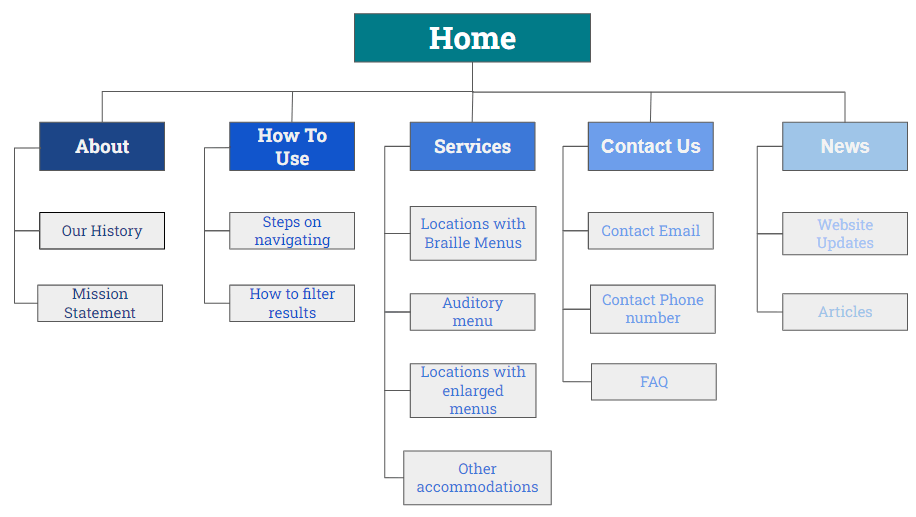
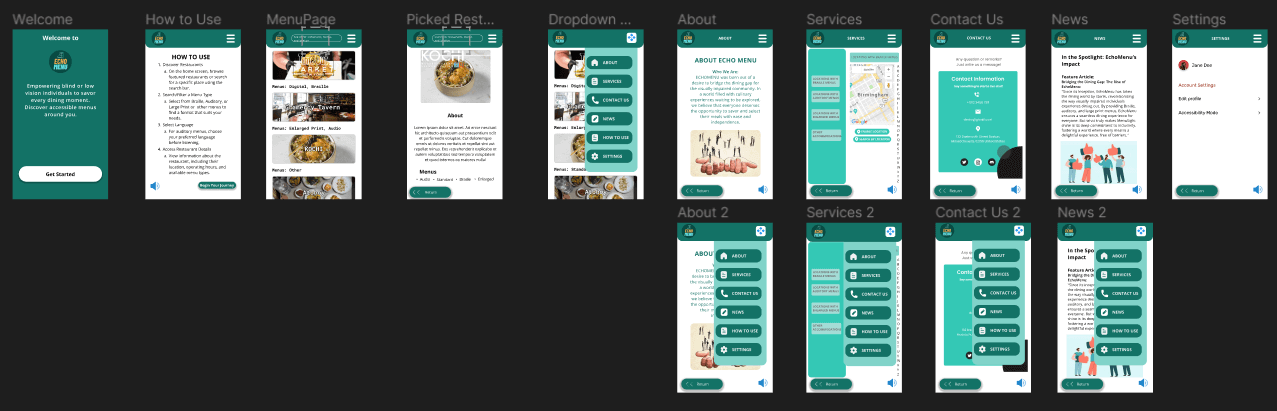
A Figma layout was created to develop the wireframes. The initial designs encountered usability issues during the class presentation, leading to a complete redesign. The new design includes prototypes and aims to improve accessibility.
5. User Testing & Task Design
- Overview of Project for Participants
- The "EchoMenu" project was presented as an app aiming to make dining inclusive. User testing tasks included finding restaurants with braille menus, accessing auditory menus, and adjusting app settings.
- Task Scenarios and Script
- Scenarios were provided to guide users through tasks such as finding braille menus, listening to menus in different languages, and customizing app settings. A 'Think Aloud' method was employed during testing.
- Feedback Collection
- Post-task questions and a user-friendly survey were used to collect feedback on app navigation, audio cues, voice commands, and overall user experience.
- Revisions
- Revisions are based on user testing feedback, particularly focusing on enhancing the wireframes and improving the usability of the app's features.
User Testing Tasks
- Finding a Restaurant Offering a Braille Menu
- Accessing and Listening to the app in Auditory (in a Chosen Language)
- Adjusting App Settings Using Voice Commands or Accessibility Features (including in “standard” setting)
Task Scenarios
Task Scenario 1
You prefer Braille menus and you want to find a nearby restaurant that offers this option. Your task is to find such a restaurant using EchoMenu with your desired location
Task Scenario 2
You're interested in hearing the menu in French. Find a restaurant that provides auditory menus and select the French language option to listen to the menu.
Task Scenario 3
You need to adjust the app's settings for a better experience, such as increasing text size or enabling a high-contrast mode, using the app's voice commands or built-in accessibility features.
 Echo Menu: User Testing Script
6. Final Presentation
7. Reflections
Recognizing the limitations of braille literacy among blind individuals and acknowledging the need for broader accessibility options. The design process emphasized the importance of inclusivity and adaptability. This also includes low-vision individuals to incorporate menus that are enlarged and even auditory menus for blind individuals as well. There will be a few design issues that will come along the way and how well adept customers are with technology will be a huge factor as well. Some feedback we received based on the presentation were online options, automatic audio, one that shows all menu, and permissions and authorizations from restaurants.